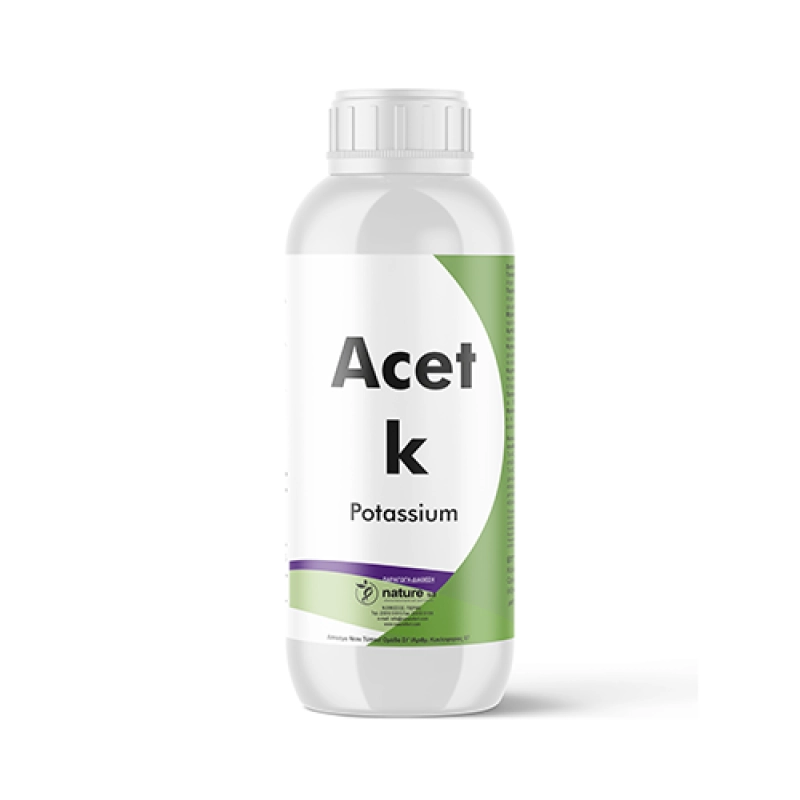
Acet K has been developed to supply potassium to plants in a highly available form that is particularly suitable for foliar application. The formulation of Acet K is based on the form "potassium acetate” which, due to its small molecular size and the plant’s natural affinity for organic carboxylic acids, has up to several times higher foliar uptake than conventional forms of potassium fertilisers. In addition, the risk of phytotoxicity when using Acet K is extremely low.
As potassium is an essential element to give all agricultural products high quality characteristics (high sugar content, intense colour, desirable taste, etc.), Acet K is a valuable fertiliser to make the plant products marketable.
Acet K also contains a high proportion of "acetate”, a natural organic acid and plant metabolite that facilitates the absorption and transport of plant nutrients into the plants, thus increasing the effectiveness of fertilisers (e.g. Acet K promotes the absorption of iron, as the combination of potassium and organic material improves the absorption and transport of this element).
Acet K promotes the tolerance of plants to unfavourable climatic conditions, as the organic matter it contains is a source of readily available stored energy.
In addition, Acet K promotes the uptake of iron, as the combination of potassium and organic matter improves the uptake and transport of this element.
When applied through the irrigation system, it regulates the pH of the soil around the root system, which in turn improves the conditions for the growth of the microorganism population.
Acet K can be applied via foliar applications or fertigation and is recommended after fruit set until harvest.
Dosages
Vegetables (tomato – cucumber – pepper – aubergine)
Fertigation
1st application 10 – 15 L / ha after the first fruit set.
Subsequent applications with 15 – 20 L / ha every 15 days.
Foliar application 2 – 4 L / 1000 L water, during the same periods as above.
Watermelons – Melons
Fertigation
1st application 15 – 20 L / ha after the first fruit set.
Subsequent applications with 15 – 20 L / ha at the same dosage every 15 days.
Foliar application
3 – 4 L / 1000 L water, during the same periods as above.
Strawberries
Fertigation
1st application 15 – 20 L / ha after the first fruit set.
Subsequent applications with 15 – 20 L / ha at the same dosage every 15 days.
Foliar application
3 – 4 L / 1000 L water, during the same periods as above.
Onion – Garlic – Carrot
Fertigation
1st application 10 – 15 L / ha after onion formation
2nd application with 15 – 20 L / ha every 15 days.
Foliar application
2 – 4 L / 1000 L water, during the same periods as above.
Potatoes
Fertigation
1st application 10 – 15 L / ha after the start of potato formation
Subsequent applications with 15 – 20 L / ha every 15 days.
Foliar application
2 – 4 L / 1000 L water, during the same periods as above.
Pome fruit (apples-pears)
Fertigation
1st application 10 – 15 L / ha after fruit set
2nd application 15 L / ha when the color starts to change.
Foliar application
2 – 3 L / 1000 L water, during the same periods as above.
Stone fruit (peach – apricot – plum)
Fertigation
1st application with 10 – 15 L / ha after fruit set
2nd application with 15 L / ha when the color starts to change.
Foliar application
2 – 3 L / 1000 L water, during the same periods as above.
Vines
Fertigation
1st application with 10 L/ha during shoot formation.
2nd application with 10 – 15 L / ha before flowering.
3rd application: in the stage of rapid growth of the grapes with 15 – 20 L / ha.
Foliar application
3 – 4 L / 1000 L water during the same periods as above.
Olive trees
Fertigation
1st application with 15 – 20 L / ha during shoot formation
2nd application with 20 – 25 L / ha after fruit set and
3rd application with 25 L / ha in the stage of core formation
Foliar application
4 – 5 L / 1000 L of water at the same times as above
Kiwi
Fertigation
1st application with 10 L / ha during shoot formation.
2nd application with 10 – 15 L / ha before blooming.
3rd application with 15 – 20 L / ha in the stage of rapid growth of the grapes.
Foliar application
3 – 4 L / 1000L water during the same periods as above.