Loading...


Provided By
-
Sold by SupFolio Platform
Description
Seaweed extracts rich in natural cytokinines
- Induces the formation of lateral and adventitious roots, as well as root buds
- Influences physiological and biochemical processes,
- Regulates chloroplast biogenesis and function,
- Involved in cell division and increases cell wall strength
- Stimulates the growth of side shoots,
- Stimulates elongation growth of the stem
- Forms leaves and flowers,
- inhibits the aging of organs and plant tissues,
- Increases resistant to abiotic stress
- Increases physiological activity of plants and thus positively influences their yield
DESCRIPTION
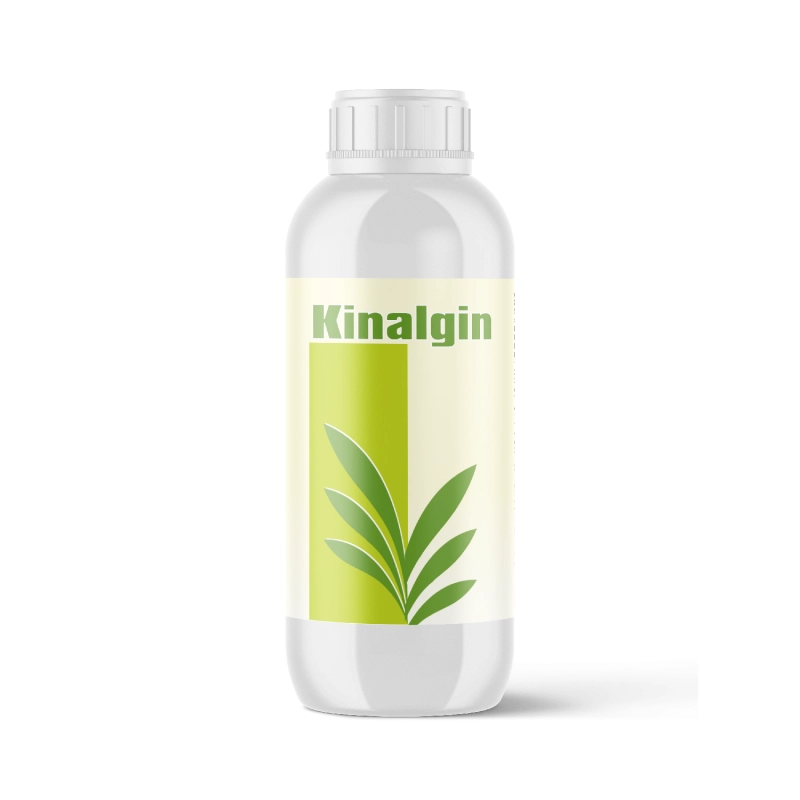
Kinalgin is a liquid biostimulant with a high content (17%) of organic matter, obtained by the cold extraction method from Ascophyllum nodosum algae and containing proteins, carbohydrates (mannitol, laminarin, algal acids, oligo- and polysaccharides), vitamins, cytokinins and auxins.
Kinalgin has all the properties of the organic substances it contains and has a positive effect on plants when applied, e.g. by inducing lateral and adventitious roots, enzymatic activity and functionality, promoting cell division, flower formation and stem elongation.
Analysis
%
Ascophylum nodosum extract15
Cytokinines 400ppm
Dosages
General fertigation dosage: 2.5 – 5L / ha in total during farming period.
General foliar dosage: 2 – 4L / 1000L of water in total during farming period.
Vegetables (tomato – cucumber – bell pepper – eggplant)
Fertigation
1st application 2.5L / ha one week after planting
Follow applications before each fruit-set with 2.5 – 5L / ha
Foliar application
2 – 4L / 1000L of water, during the same periods as above.
Leafy vegetables (cauliflower – broccoli – cabbage – lettuce)
Fertigation
1st application 2.5L / ha one week after planting
2nd application at the stage of rapid foliage growth with 2.5 – 5L / ha
3rd application at the formation of the head with 2.5 – 5L / ha
Foliar application
2 – 4L / 1000L of water, during the same periods as above.
Watermelon – melon
Fertigation
1st application 2.5L / ha one week after planting
Follow applications before each fruit-set with 2.5 – 5L / ha
Foliar application
2 – 4L / 1000L of water, during the same periods as above.
Strawberries
1st application 2.5L / ha one week after planting
Follow applications before each fruit-set with 2.5 – 5L / ha
Foliar application
2 – 4L / 1000L of water, during the same periods as above.
Onion, Garlic
Fertigation
1st application 2.5L / ha one week after planting
Follow applications before each fruit-set with 5L / ha
Foliar application
2 – 4L / 1000L of water, during the same periods as above.
Potatoes
Fertigation
1st application 2.5L / ha one week after planting
2nd application at the stage of rapid foliage growth with 5L / ha
3rd application at the formation of the tuber with 5L / ha
Foliar application
2 – 4L / 1000L of water, during the same periods as above.
Pomes (Apples-Pears)
Fertigation
1st application 4 – 5L / ha during the formation of leaf tips,
2nd application: after fruit set with 5L / ha.
Foliar application
3 – 4L / 1000L of water, during the same periods as above.
Stones fruit (Peach – Apricot – Plum)
Fertigation
1st application: after the petals fall off with 4 – 5L / ha.
2nd application: during the rapid growth of the fruit with 4 – 5L / ha.
Foliar application
3 – 4L / 1000L of water, during the same periods as above.
Citrus fruit (Lemon – Orange – Tangerine)
1st application: During shoot formation with 4L / ha.
2nd application: after fruit-set with 5L / ha.
3rd application: at the stage of rapid growth of grapes with 5L / ha.
Foliar application
3 – 4L / 1000L of water, during the same periods as above.
Vines
Fertigation
1st application: During shoot formation with 3L / ha.
2nd application: before blooming with 5L / ha.
3rd application: at the stage of rapid growth of grapes with 5L / ha.
Foliar application
2 – 4L / 1000L of water, during the same periods as above.
Olive trees
1st application: During shoot formation with 4L / ha.
2nd application: after fruit-set with 5L / ha.
3rd application: at the stage of rapid growth of grapes with 5L / ha.
Foliar application
3 – 4L / 1000L of water, during the same periods as above.
Kiwi
1st application: During shoot formation with 3L / ha.
2nd application: before blooming with 5L / ha.
3rd application: at the stage of rapid growth of grapes with 5L / ha.
Foliar application
2 – 4L / 1000L of water, during the same periods as above.
Nuts trees
Fertigation
1st application: During shoot formation with 4L / ha.
2nd application: before blooming with 5L / ha.
3rd application: at the stage of rapid growth of husks with 5L / ha.
Foliar application
2 – 4L / 1000L of water, during the same periods as above.
Greenhouses
The lowest dosage is recommended.
Nurseries (horticulture, tobacco, floriculture):
5L / ha when moistening the soil or when sowing topsoil.
When transplanting:
Soak the plants in a 2% solution.
Shop Policies
Operational policy
Test
Delivery Policy
test
Refund Policy
Test