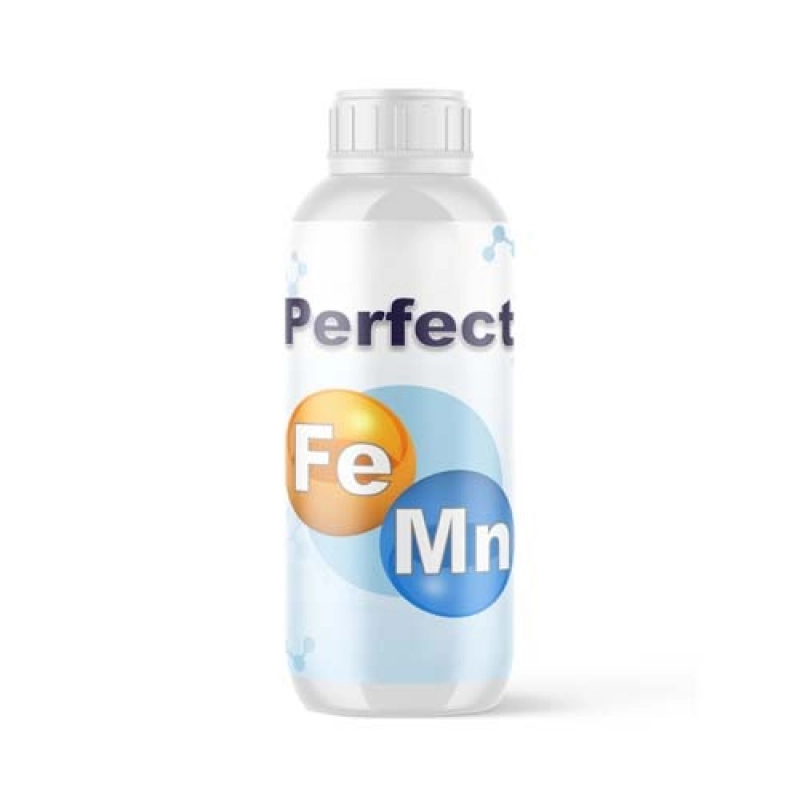
Perfect Fe/Mn is a rich source of assimilable iron and manganese in the form of a complete EDTA chelate. In addition, this product contains bioactive factors that play a crucial role in the uptake of this product by the epidermal cells of the leaves.
Perfect Fe/Mn contributes to the process of photosynthesis, increases overall production and improves qualitative properties, while at the same time it has the task of regulating a number of enzymatic reactions and the availability of nutrients in plants. The lack of Fe and Mn is often a major problem in calcareous soils with an alkaline pH or in very acidic and slightly sandy soils that are poor in organic matter.
Dosages
General fertigation dosage: 15 – 30 L / ha in total during farming period.
General foliar dosage: 1.5 – 3 L / 1000 L of water in total during farming period.
Vegetables (tomato – cucumber – bell pepper – eggplant)
Fertigation
1st application 15 L / ha one week after planting
Follow applications before each fruit-set with 20 – 25 L / ha
Foliar application
2 – 3 L / 1000 L of water, during the same periods as above.
Leafy vegetables (cauliflower – broccoli – cabbage – lettuce)
Fertigation
1st application 15 L / ha one week after planting
2nd application at the stage of rapid foliage growth with 20 – 25 L / ha
3rdapplication at the formation of the head with 25 L / ha
Foliar application
2 – 3 L / 1000 L of water, during the same periods as above.
Watermelon – melon
Fertigation
1st application 15 L / ha one week after planting
Follow applications before each fruit-set with 20 – 25 L / ha
Foliar application
2 – 3 L / 1000 L of water, during the same periods as above.
Strawberries
Fertigation
1st application 15 L / ha one week after planting
Follow applications before each fruit-set with 15 – 20 L / ha
Foliar application
2 – 3 L / 1000L of water, during the same periods as above.
Onion – Gerlic
Fertigation
1st application 15 L / ha one week after planting
Follow applications before each fruit-set with 15 – 20 L / ha
Foliar application
2 – 3 L / 1000L of water, during the same periods as above.
Potatoes
Fertigation
1st application 15 L / ha one week after planting
2nd application at the stage of rapid foliage growth with 20 – 25 L / ha
3rd application at the formation of the tuber with 25 L / ha
Foliar application
2 – 3 L / 1000 L of water, during the same periods as above.
Pomes (Apples-Pears)
Fertigation
1st application 20 L / ha during the formation of leaf tips,
2nd application: after fruit set with 25 L / ha.
Foliar application
2 – 3 L / 1000 L of water, during the same periods as above.
Stones fruit (Peach – Apricot – Plum)
Fertigation
1st application: after the petals fall off with 20 L / ha.
2nd application: during the rapid growth of the fruit with 25 L / ha.
Foliar application
2 – 3 L / 1000 L of water, during the same periods as above.
Vines
Fertigation
1st application: During shoot formation with 15 – 20 L / ha.
2nd application: before blooming with 20 – 25 L / ha.
3rd application: at the stage of rapid growth of grapes with 25 L / ha.
Foliar application
3 – 4 L / 1000 L of water, during the same periods as above.
Kiwi
Fertigation
1st application: During shoot formation with 15 L / ha.
2nd application: before blooming with 20 – 25 L / ha.
3rd application: at the stage of rapid growth of grapes with 25 L / ha.
Foliar application
2 – 3 L / 1000L of water, during the same periods as above.
Olive trees:
Fertigation
1st application: During shoot formation with 15 – 20 L / ha
2nd application: after fruit set and with 20 – 25 L / ha
3rd application: at the stage of core formation with 2 5L / ha
Foliar application
3 – 4 L / 1000 L of water, during the same periods as above
Citrus fruit (Lemon – Orange – Tangerine)
1st application: During shoot formation with 4 L / ha.
2nd application: after fruit-set with 5 L / ha.
3rd application: at the stage of rapid growth of grapes with 5 L / ha.
Foliar application
2 – 3 L / 1000 L of water, during the same periods as above.
Nuts trees
Fertigation
1st application: During shoot formation with 15 L / ha.
2nd application: before blooming with 15 – 20 L / ha.
3rd application: at the stage of rapid growth of husks with 25 L / ha.
Foliar application
2 – 3 L / 1000 L of water, during the same periods as above.
Greenhouses
The lowest dosage is recommended.